- +91 9406205550
-


.png)

.png)
.png)
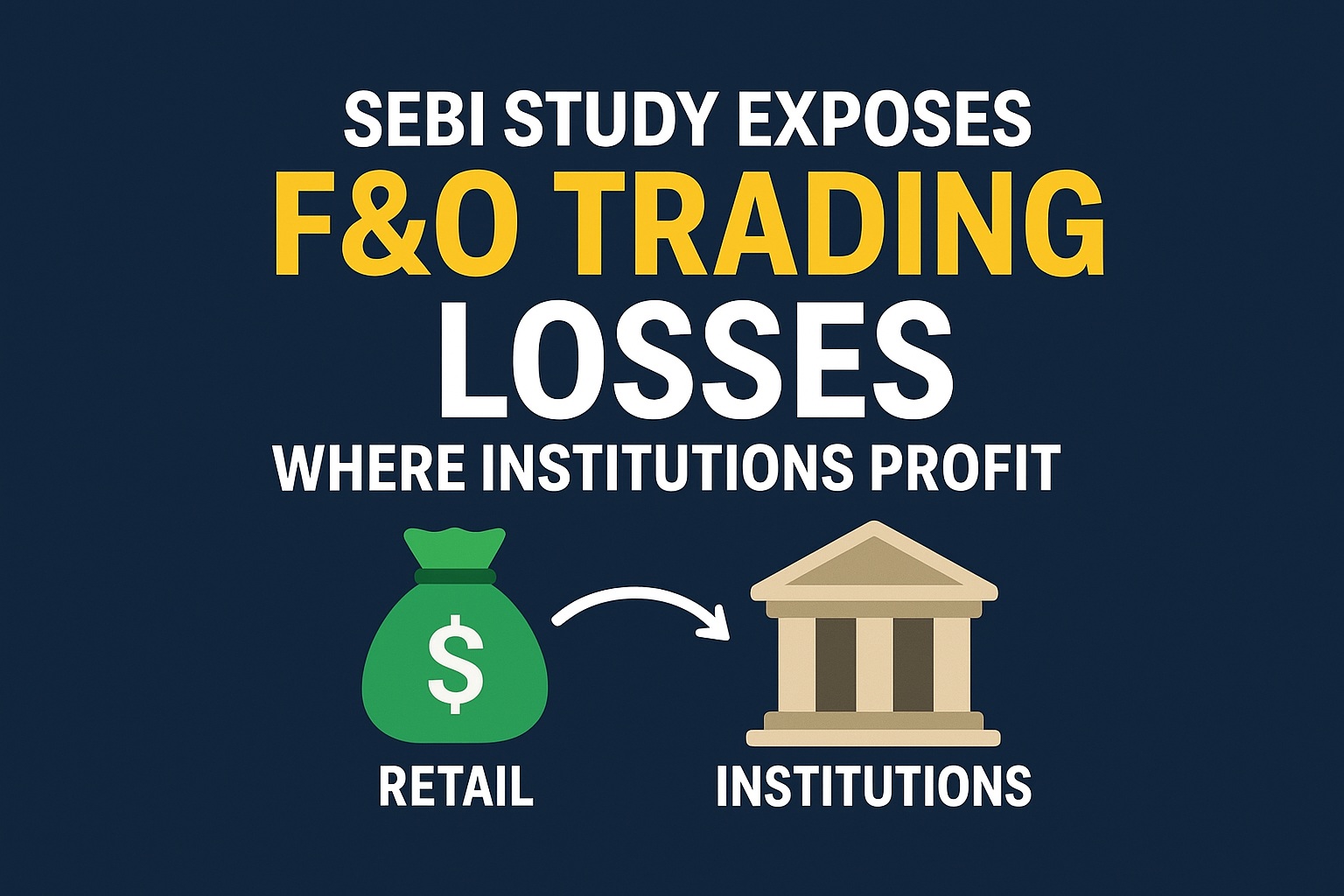
SEBI Study Confirms: F&O Trading Remains a Zero-Sum Game Where Institutions Win and Retail Investors Lose
The Securities and Exchange Board of India (SEBI) has recently released a comprehensive study on trading patterns and profitability in the equity Futures & Options (F&O) segment between FY22 and FY24. The results reinforce a critical reality of India’s markets—F&O trading is a zero-sum game, where institutional participants consistently profit at the expense of retail investors.
Over the three-year period, 93% of individual F&O traders suffered losses, with cumulative retail losses amounting to an alarming ₹1.8 lakh crore. The data leaves little room for doubt: while large institutional entities, proprietary traders, and foreign portfolio investors (FPIs) steadily accumulate profits, the retail investor base continues to absorb the losses.
A Structural Disadvantage for Retail Participants
SEBI’s findings underline how unequal the playing field is:
This confirms that institutional dominance ensures consistent wealth transfer from retail to sophisticated players.
How F&O is Marketed to Retail Investors
The question arises: if the odds are so unfavorable, why do retail investors continue to participate?
The answer lies in the manner in which F&O products are popularized. Exchanges, brokers, and market intermediaries have a vested interest in encouraging retail participation, as transaction volumes directly translate into higher brokerage, fees, and exchange revenues.
This push is amplified by finfluencers, online “mentors,” and trading platforms that advertise unrealistic returns, often showcasing selective profits while concealing the overwhelming likelihood of losses. Retail investors are systematically led to believe that F&O trading offers a quick path to financial independence, when in reality, it functions as a mechanism to channel their money into institutional hands.
Real-World Examples of Exploitation
The dangers are not confined to market losses alone. Several cases of outright fraud and mis-selling have emerged in recent years:
Such instances highlight how the lure of extraordinary profits makes retail investors vulnerable both to market losses and criminal exploitation.
A Better Alternative: Long-Term Investing Over Short-Term Speculation
The SEBI study provides clear evidence: F&O trading is not wealth creation; it is wealth redistribution—from retail to institutional participants.
Instead of speculative trading, investors seeking sustainable wealth creation should focus on regulated, long-term investment vehicles such as mutual funds, index funds, and systematic investment plans (SIPs). These instruments are professionally managed, diversified, and designed to build wealth steadily over time rather than destroy it through leverage and speculation.
Conclusion
The recent SEBI report is a reminder that F&O trading is structurally designed to favor large, sophisticated players, while retail investors remain on the losing side. Its continued promotion among individuals—through exchanges, brokers, and finfluencers—raises serious concerns, as it not only drains personal savings but also undermines financial security for millions.
For retail investors, the message is unambiguous: stay cautious, avoid being drawn into schemes that promise extraordinary returns, and focus instead on disciplined, long-term investing.
📌 Disclaimer
Mutual fund investments are subject to market risks. Read all scheme-related documents carefully before investing. Past performance is not indicative of future returns. This article is for informational and educational purposes only and does not constitute investment advice. The content has been drafted and refined with the assistance of ChatGPT, an AI writing tool, for clarity and readability.
Office Phone :
(+91) 9406205550
Bachat Plus
62/6 Nehru Nagar East,
Agrasen Marg, Bhilai,
C.G. 490020
Mutual fund investments are subject to market Risk please read offer documents carefully before investing.
Mon - Sat : 10:00 AM to 5:00 PM
Sunday : Closed
Risk Factors – Investments in Mutual Funds are subject to Market Risks. Read all scheme related documents carefully before investing. Mutual Fund Schemes do not assure or guarantee any returns. Past performances of any Mutual Fund Scheme may or may not be sustained in future. There is no guarantee that the investment objective of any suggested scheme shall be achieved. All existing and prospective investors are advised to check and evaluate the Exit loads and other cost structure (TER) applicable at the time of making the investment before finalizing on any investment decision for Mutual Funds schemes. We deal in Regular Plans only for Mutual Fund Schemes and earn a Trailing Commission on client investments. Disclosure For Commission earnings is made to clients at the time of investments.
Palash Singhania AMFI Registered Mutual Fund Distributor – ARN-99688 | Date of initial registration – 08-Jan-2015 | Current validity of ARN – 10-Sep-2029
Palash Singhania AMFI Registered SIF ARN-99688 | Date of initial registration –08-July-2025 | Current validity of ARN – 09-Mar-2028
Bachatplus APMI Registration number APRN00285 valid up to 20-3-2027
Important Links | Disclaimer | Disclosure | Privacy Policy | SID/SAI/KIM | Code of Conduct | SEBI Circulars | AMFI Risk Factors | Registration Disclosure